
When Young People Disappear from View: What Our Community of Practice Taught Us About Hikikomori
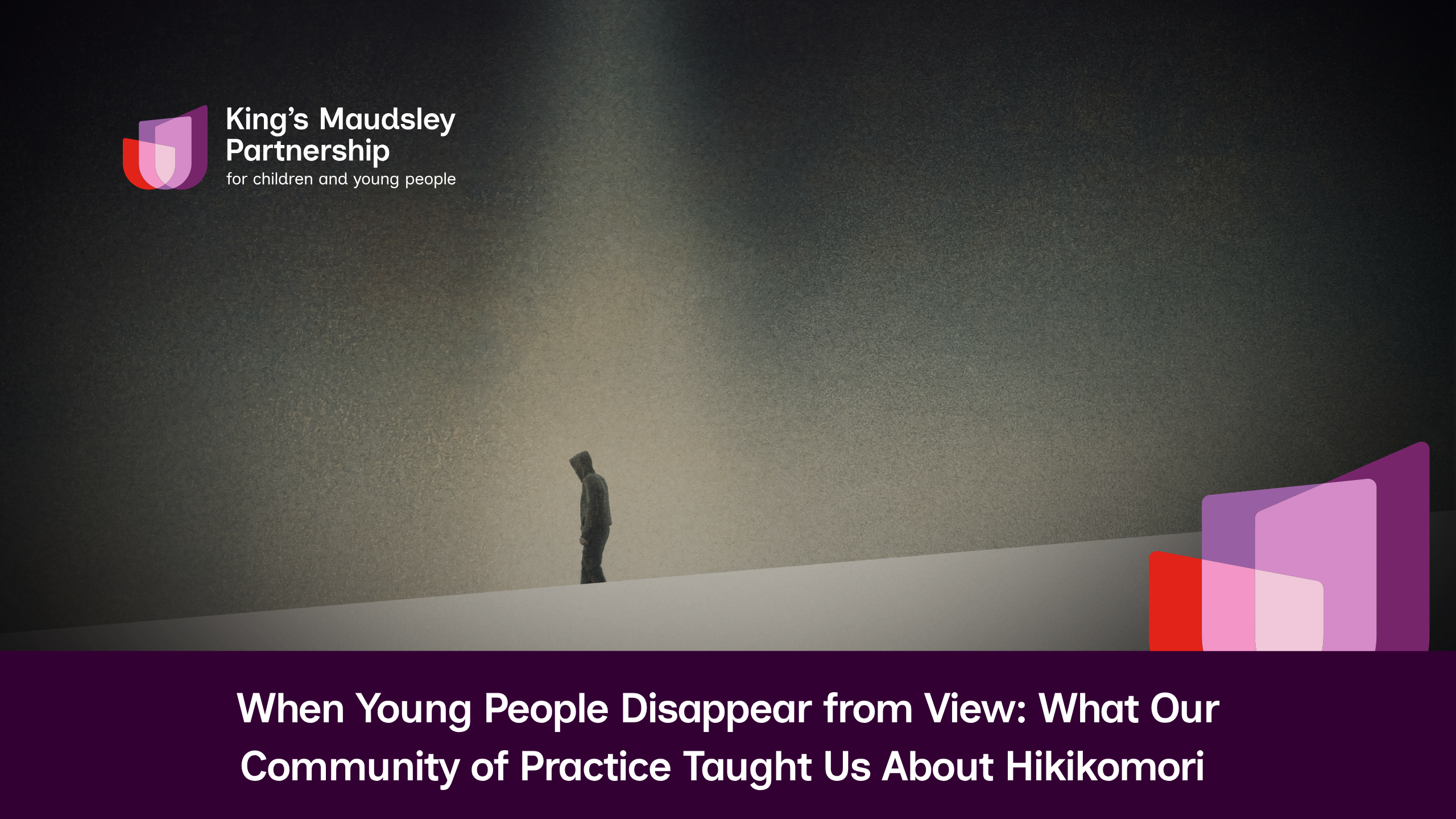
What happens when a young person slowly retreats from the world?
They stop attending school. They rarely leave their room. Appointments go unanswered. Professionals worry; families struggle; systems feel stuck. Yet no single diagnosis quite captures what is happening.
At our April Affective Disorders Community of Practice (CoP), clinicians, researchers and system leaders from across the King’s Maudsley Partnership came together to explore a growing but under‑defined phenomenon often referred to as hikikomori—a term first used in Japan to describe severe and prolonged social withdrawal, but increasingly recognised far beyond cultural boundaries.
What emerged from the discussion was not a call for a new diagnostic label, but something more grounded — and more urgent.
Not just a Diagnosis; a Daily Clinical Reality
Across services, clinicians described encountering young people who are profoundly socially withdrawn, often for months or years at a time. While some meet thresholds for recognised conditions such as depression, anxiety, autism or psychosis, others may not. Individuals often present with comorbidity –a complex mix of symptoms, not fully satisfying any single diagnostic category.
The group was clear: hikikomori is best understood as a transdiagnostic presentation, rather than a disorder in its own right.
It can be:
- An endpoint of multiple conditions
- A response to accumulated stress, adversity or unmet needs
- A rejection of societal pressures in favour of a retreat seen as protective
- A deeply distressing experience of loneliness
What unites these young people is not diagnosis, but functional impact: disengagement from education, limited community presence, and increasing invisibility within systems designed around attendance and engagement.
Engagement Is the Key Challenge
One of the most consistent themes was the difficulty of engagement.
Many socially withdrawn young people:
- Do not attend clinics
- Are unreachable by phone or email
- Do not respond to standard interventions
Even intensive efforts such as home visits may result in little or no direct contact. This leaves clinicians holding significant concern, but with limited tools or authority to act — a situation that creates both ethical tension and medico‑legal anxiety.
Participants noted that current service models often assume that the young person will eventually come through the door. For this group, that assumption frequently does not hold.
Families, Systems, and the Wider Context Matter
The discussion repeatedly moved beyond the individual to consider maintenance factors:
- The role of family dynamics and parental mental health
- How staying at home can become unintentionally reinforced
- The shift from in‑person to online social worlds
- The impact of reduced community and youth resources
Importantly, participants emphasised that many socially withdrawn young people are not completely disconnected. Some are deeply engaged in online gaming, forums or digital communities — raising questions about how we define “isolation” in a digitally mediated world.
Is withdrawal always distressing?
Or can it sometimes feel safer than the alternatives available?
If so, what can mental health services do to help make the outside world seem less threatening?
Understanding these nuances was widely seen as essential for meaningful engagement.
What Clinicians Are Asking For: Pathways, Not Labels
Rather than debating whether hikikomori deserves its own diagnostic category, the CoP focused on a more practical question:
What would help clinicians and services respond better to such presentations?
Several priorities emerged:
- A shared working definition to support consistency
- Clear care pathways for non‑engagement
- Guidance on risk management and escalation
- Stronger multi‑agency alignment across health, education and social care
Participants highlighted the need for tools that are defensible, flexible and grounded in clinical reality, rather than idealised research settings.
Research – But Embedded in Practice
There was strong enthusiasm for research — if it is done with services, not to them.
The group favoured:
- Clinically-focused methodology to determine what is actually happening in practice
- Qualitative approaches that capture lived experience
- Longitudinal perspectives to understand trajectories and recovery
- Implementation‑focused work that tests what actually fits within busy CAMHS teams
Crucially, clinicians emphasised the need for protected time, practical support, and co‑production with young people and families — without adding unsustainable burden to already stretched teams.
Looking Ahead: From Conversation to Change
This Community of Practice reinforced something powerful: when clinicians, researchers and system leaders think together, complex problems become clearer — even if solutions are not yet simple.
Severe social withdrawal challenges many of our assumptions about access, engagement and responsibility in mental health services. Addressing it will require shared language, better pathways, and service‑embedded innovation.
At King’s Maudsley Partnership, we see Communities of Practice as spaces where emerging challenges can be named, examined and shaped into meaningful action. This conversation on hikikomori is only the beginning — but it is a vital one.
If you want to learn more about Hikikomori and our work in this area please contact us on KMPCYP@slam.nhs.uk. Learn more about the Pears Maudsley Centre.
Learn more about Dr Marcus Tan and his work.
Categories
Follow Us
For the latest updates and news, follow us on our social channels.
Sign up to our newsletter for more updates on the Pears Maudsley Centre and for ways you can get involved!